Showing posts with label baltimore. Show all posts

Sunday, September 27, 2015

Turning Ellicott City's Main Street into a Pedestrian Street?

I've been recently thinking about the concept of turning Ellicott City's Historic Main Street into a pedestrian-only zone, removing vehicles from the corridor. The thought came into my mind after going to Ellicott City's MusicFest this past weekend, and realizing how congested the downtown area becomes when cars and pedestrians fight for space. This got me thinking, wouldn't sectioning off this main artery for pedestrians, increase visitors and enhance the Ellicott City experience?

Ellicott City's Main Street


This concept has been implemented in many cities across the United States, like Cumberland in Western Maryland, and New York's Ithaca in the Finger Lakes. Those communities are now celebrated for their pedestrian-friendly atmospheres; something that E.C. is certainly lacking. Whenever I travel to Main Street, the feeling of being taken back in time quickly disappears when traffic snarls up Maryland's Route 144. During a normal day, parking usually isn't too much of an issue because of the city's many free visitor parking lots. However, when walking down Main Street, you are mere inches away from cars much of the time, causing a sense of claustrophobia and danger. So I went to my Google Maps, and created a new plan for my version of the new Ellicott City.


My proposed plan includes a new bypass for Historic Ellicott City, by rerouting traffic on a new road that I've coined "Ellicott City Parkway". This new parkway would leave old Frederick Road in Oella, and cross the Patapsco River undercutting south of Ellicott City. The new road would intersect all of the major roads on the south side: College Avenue, New Cut Road and Old Columbia Pike. The bypass would terminate and join Rogers Avenue at the intersection of old Frederick Road/Main Street on the west side. Manahan Drive is also extended to intersect the new bypass to increase connectivity. I've also added a new bikeway/path and a park on this new road in order to increase access to greenspace and the historic district.

A design for Ithaca's Pedestrian Mall.

For the pedestrian zone, Main Street would be sectioned off from Old Columbia Pike to the west end, and Maryland Avenue to the east end. All of Main Street from those two points, and Tiber Alley would be only used by pedestrians and authorized vehicles. This new zone would be the perfect place for entertainers (like that Bubble Blowing guy that's always there, ghost tours, festivals, and socializing). Old Columbia Pike and Main Street could also include a drop off zone area at the curve.
Of course this plan would require extensive work, and might not even be allowed due to historic conditions under the historic district and the Historic National Road (MD 144). Either way, it is worth thinking about how we can make Ellicott City more pedestrian and biker friendly.

Thursday, February 26, 2015

Centre Theatre: Preliminary Research Findings

Centre Theatre
10 E. North Ave
Baltimore, MD 21218

The Centre Theatre was constructed in 1939 as a studio theatre and a broadcasting center for WFBR. It is located in Station North Arts and Entertainment District on the first block of east North Avenue on the north side of the street. It is currently being restored to become a mixed use development that will include spaces for film screenings, music venues, artists’ studios, galleries, a playhouse and a restaurant.


Timeline:

  • Constructed with $400,000 by Morris A. Mechanic. Building was designed by Philadelphia architect Armand Carroll.
  • Opened 2/2/1939
  • Operated as a studio theatre and a broadcasting center for WFBR.
  • It was the first theatre in the city equipped for radio broadcasting in-house (other theatres had broadcast via remote before) and the first with the ability to project live television on the screen.
  • Closed on 4/16/1959 after the Equitable Trust Company announced plans to enlarge the complex and move their operations department in early 1960
  • The bank planned to add a third story and "special dust-free areas... to create the exact atmospheric conditions required for the most efficient use of highly sensitive automated electronic equipment." One example offered for this new equipment included a $55,000 sorting machine that sorted checks and other documents at a rate of 1,000 a minute guided by "magnetic ink" rather than "the familiar punch card holes." 
  • Purchased by a church in the 1990s
  • Jubilee Baltimore purchased the property in July 2011 during a public auction for $93,000.

List of contacts:

Jubilee Baltimore
Charles Duff, President/Current owner 
410.327.7373 x101 
charlie@jubileebaltimore.org

Ziger/Snead Architects
Steve Ziger, Project Architect/Partner
sziger@zigersnead.com

Maryland Institute College of Art
Fred Lazarus, President

North Avenue Market
Michael L. Shecter
Carolyn E. Frenkil

Sources:

http://articles.baltimoresun.com/2012-02-06/news/bs-md-ci-theater-20120206_1_arts-district-central-baltimore-partnership-film-screenings

http://www.bizjournals.com/baltimore/news/2013/06/03/mica-johns-hopkins-film-program-part.html

http://retrobaltimore.tumblr.com/post/81719245787/jacques-kelly-centre-theater-in-ruins-but

http://cinematreasures.org/theaters/5552/photos 

http://explore.baltimoreheritage.org/items/show/17#.VO6nqlPF93U

http://www.zigersnead.com/projects/details/10-east-north-avenue-mixed-use-redevelopment/


Thursday, February 19, 2015

Adventure 1: Morning in Station North and First Time at Red Emma's

For my first adventure for Community in America (AMST 380), I wanted to experience and explore Station North during the morning hours. In my experience, the morning is always a great way to get a true feel for a particular location when everyone is just beginning to get on with their day.


On the cold winter morning of February 19, I wandered about the neighborhood scoping out landmarks that I know of, seeking out new changes since the last time I passed through. I was very impressed by the changes I observed. In particular, I was happy to see the restoration of The Centre theatre under way with the new vintage sign already up. I can already imagine how great North Avenue is going to look with the additions of the historic theaters of Parkway and Centre! Even though the day was bitterly cold, the sun was shining brightly on the beautifully unique facades of the boulevard.

Interior of Red Emma's in Station North.

I've heard a lot about Red Emma's from friends of mine, but I never got a clear sense of their experience. Nevertheless, I have been wanting to check it out since the business moved into the historic North Avenue Market building from their old location in Mount Vernon. As I was walking up to the door, I took a survey of the locals. There is definitely diversity when it comes to Station North, but I think it could also be characterized by extremes. On one end you have your typical Baltimore mix of working class people and the occasional homeless individual, but on the other end you have the obvious art student (who may or may not have a trust fund, and may or may not be from here). Not that there's anything wrong with that, but I think it's important to note the differences especially in a changing neighborhood like Station North.

My delicious Red Emma's coffee!

Overall, Red Emma's turned out to be a great experience! As soon as I stepped in, I immediately fell in love with the interior design of the space. I ordered a coffee with the Colombian blend, and it really hit the spot after being out in the cold. Compared to other local coffee places like Dooby's and Donna's, Red Emma's was a lot friendlier, cheaper, and had less of an attitude. Could this be because they moved to Station North where everything seems to be more laid back and less segregated than other parts of Baltimore? Maybe, maybe not. After I got my coffee, I browsed through their interesting book collection, and then found a table by the window and studied for a bit. As my adventure came to a close, I realized that Red Emma's provides a sanctuary in the middle of the city, of both calmness and equality. Unlike national chains, everyone is allowed to enter to enjoy the experience.

Tuesday, February 17, 2015

Looking Forward: "Can Station North Save the City?"

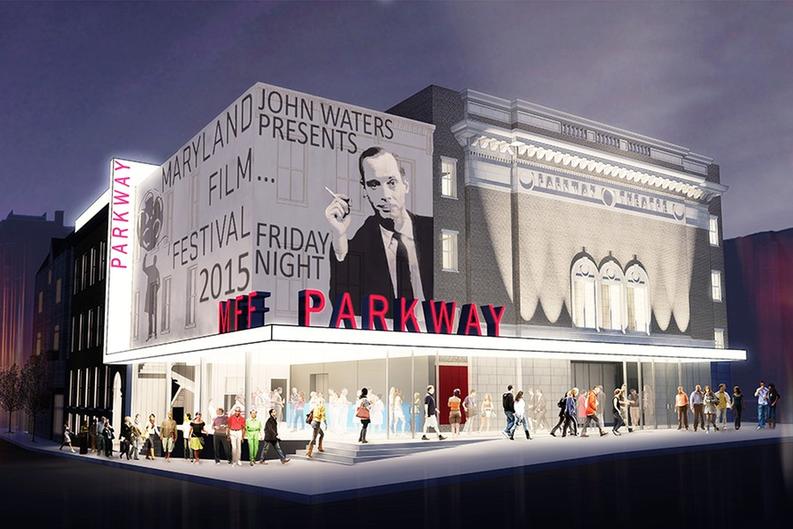
The renovation of The Parkway theatre would be a game-changer for the development of Station North.

The Marc Steiner Show on WEAA 88.9 FM asked this question of the relatively new neighborhood of Station North Arts & Entertainment District, along with discussing the connected topics of revitalization, gentrification, and the state of arts in Baltimore. One of the city's most changing communities, Station North has numerous projects in the works in order to revitalize the neighborhood like the restoration of the Parkway and Centre Theaters on North Avenue.

Ben Stone, the executive director of Station North Arts and Entertainment Inc., spoke about the mission of the neighborhood. He stressed the importance of inclusion of all residents, no matter how long they have resided in the area. A common concern that was addressed was the issue of displacement over the long term due to the gentrification of the neighborhood. Stone along with other members of the panel were all in agreement that they would like to avoid hyper-gentrification and displacing residents.

In my opinion, I believe that Station North has been doing a good job so far through its development process. Namely, I think that Station North utilizes transparency and encourages the inclusion of others in the community. From my experience working on Section.1 Park, inclusion and nondiscrimination are common themes throughout the project, so that nobody is left out of the experience. Overall, I believe that the projects going on at Station North will greatly help the city.

Ben Stone, Executive Director of Station North Arts and Entertainment Inc.
Three main questions that I would extend to Ben Stone would be:

  1. How can we sustain the development brought by Station North, and extend it into neighboring areas? In other words, how can we take advantage of this development and bring it into decayed areas surrounding Station North?
  2. Is there a way to bridge the different "layers" found in Station North? Can we unite students, working-class individuals and artists through community functions and urban planning?
  3. Will families and others outside the city have a place in the long term plans for Station North? I think there needs to be more contribution from other institutions that are not immediately located around Station North (i.e. MICA/UB/etc.) 


Thursday, February 5, 2015

Introduction: Building Community in Changing Neighborhoods

Community, Gentrification, and Station North

A sense of community is essential to the health and success of a group of individuals. Without the presence of a community, the group slowly weakens and disconnects. I believe that the process of gentrification can be both good and bad, often depending on the neighborhood at hand. If a sense of community is absent from a particular community, gentrification could often take place to fill the void. For neighborhoods such as these, I think gentrification can be useful so that the neighborhood can return to a vital state.


Station North is a unique example of a changing neighborhood in Baltimore. Many claim that Station North is an example of gentrification, but I disagree. As a child, I remember North Avenue before the creation of the arts district. At that time during the late 1990s/early 2000s, the area was dilapidated, depressing, and lacked development of any kind. Presently, Station North has transformed the North Avenue corridor to a vibrant arts community for everyone to enjoy. 


For our class, Community in America, I think it would be great to focus on the spatial aspect of community in Station North. As an intern for the Section.1 Art Park project, we focus on how we can create a public space for everyone in the neighborhood and Baltimore as a whole. Our class project could elaborate on this concept, and look in detail at the changing spaces around Station North. By associating these spaces with people, we can get a better idea of how these changes impact the individuals around them.